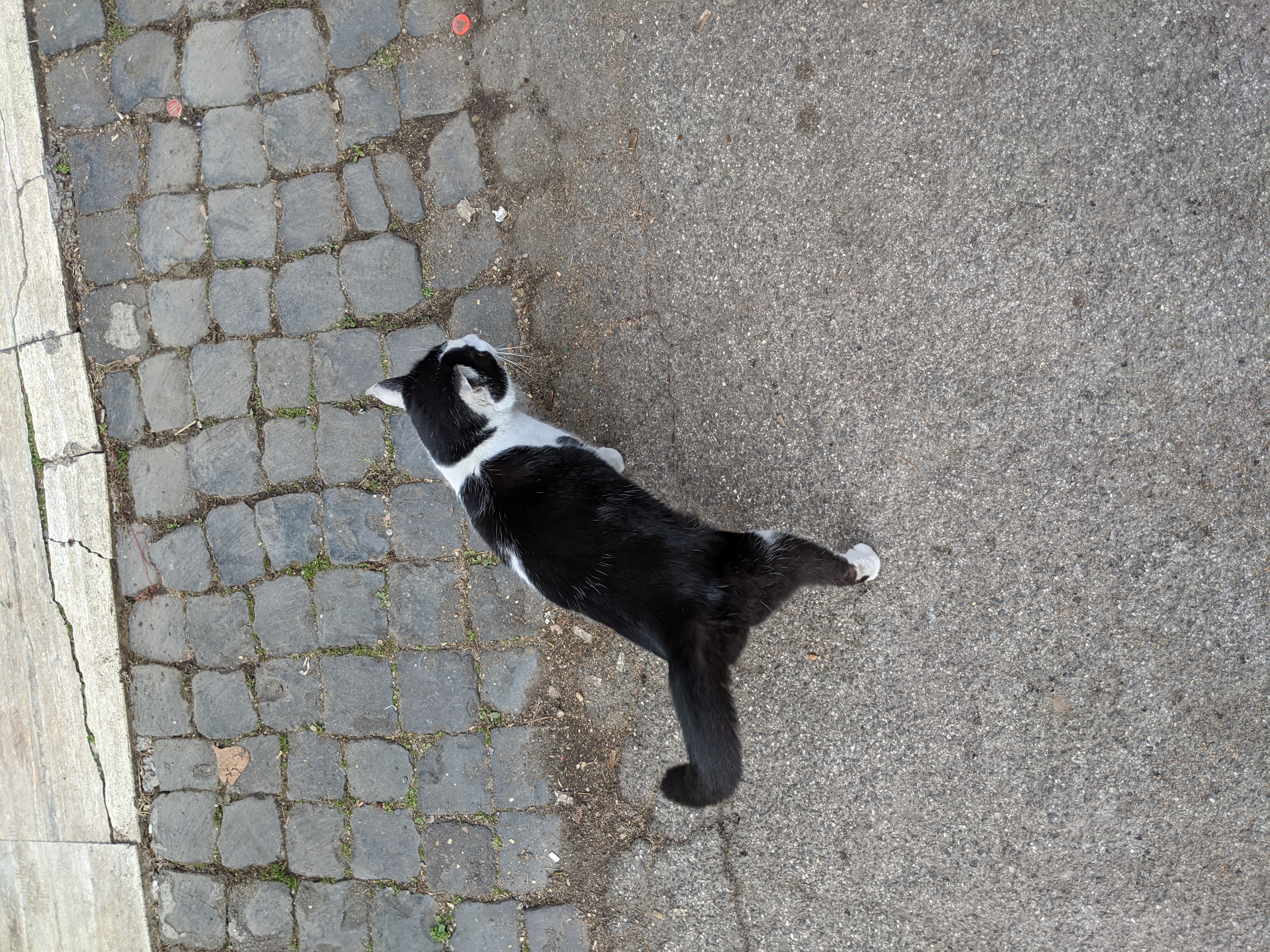
Study Abroad Part One
tags: Study Abroad, Europe
Arriving; Sedimentary; Campaign Bridges; Cobblestone Voices; Rome Ripped my Jeans
Welcome to my first Study Abroad Blog Post! I will be investigating the role of road systems in cities while exploring Rome, as a part of a semester-long project through the McBride Honors Program at the Colorado School of Mines. This experience, among many personal, spiritual, and academic motivations, is an opportunity to practice many of the interpersonal, analytical, and research skills I have been learning at Mines (hence the name: Practicum). Adapt, share, experience, investigate, assimilate… just a few of the verbs I would use to describe this trip. FYI, before traveling to Rome, I wrote a research paper on road systems, which can be found here. Now on with the post!
✈️ Arriving
9am. In the fog of jetlag and a Mediterranean sea breeze, I made my way from the Fiumicino Airport to Rome’s quaint Trastevere neighborhood. On the way, I took note of the narrow, elevated highways of the outer city. Cars, buses and trucks alike drove with incredible speed, changing lanes, merging and honking with no fear of crashing or hurting each other’s feelings. Aggressive driving was seemingly the norm (something I have already gotten very used to while living here). After a few tight turns, some of which I thought to be impossible, and a few bridge crossings later, we arrived at the apartments. When I stepped off the bus, only in the bowels of my head-ached mind did I fully realize I was in the middle of the Eternal City. An instinctive mission took over my body, and with the little energy I had left, I found my room and took to a sobering dreamless sleep.
🍰 Sedimentary
I can feel, hear, see, touch and smell the history in Rome, deeply layered in the fabric of the city. As I walk from my apartment to class, from class to dinner, and from dinner to the river, it is clear that I am using roads traversed by thousands, if not millions before me, for thousands of years. A city this old has a few obvious and subtle hints to its age. Of course, as I walk under an arch from the 3rd century CE, it is clear that physical monuments reveal a city strewn through time, the tufa and marble of an infrastructure once at the center of a Mediterranean Republic embedded in the hills. The Colosseum, Roman Forum, Pantheon and other famous sights in Rome, all of which I visited in this first week, are quite large reminders of this ancient presence. But, it is in a deeper analysis of the city… and I mean deeper literally, that more subtle things emerge. When I first walked along the Tiber River, I made note of steep walls which extend from the stone river banks to the city “ground-zero.” It was after a discussion in my first on-site class (titled Ancient Rome and its Monuments, taught by Professor Hansen, a seriously amazing historian and teacher who finds ancient monuments “sexy”) that I realized the entire city is built upon older versions of itself. Many of the ancient monuments in Rome are nearer to the level of the river, hidden in pits around the city, viewable by railing from the sidewalk. Might I say… Rome is sedimentary.
📜 Campaign Bridges
It was also during my first on-site class that we discussed bridges, and their importance to Rome’s ancient road system. During the early years of ancient Rome, the city was responsible for much of the commerce from northern Italy to the Mediterranean via the Tiber River. Thus, crossing the river had great economic value, leading to the strategic construction of bridges. Yes, “All Roads Lead to Rome”, but this is also partially true before it was the center of the Roman Empire. One such bridge, built by Lucio Fabricio around 62-23 BC, is one of two bridges to connect Tiber Island to the mainland, pictured below.
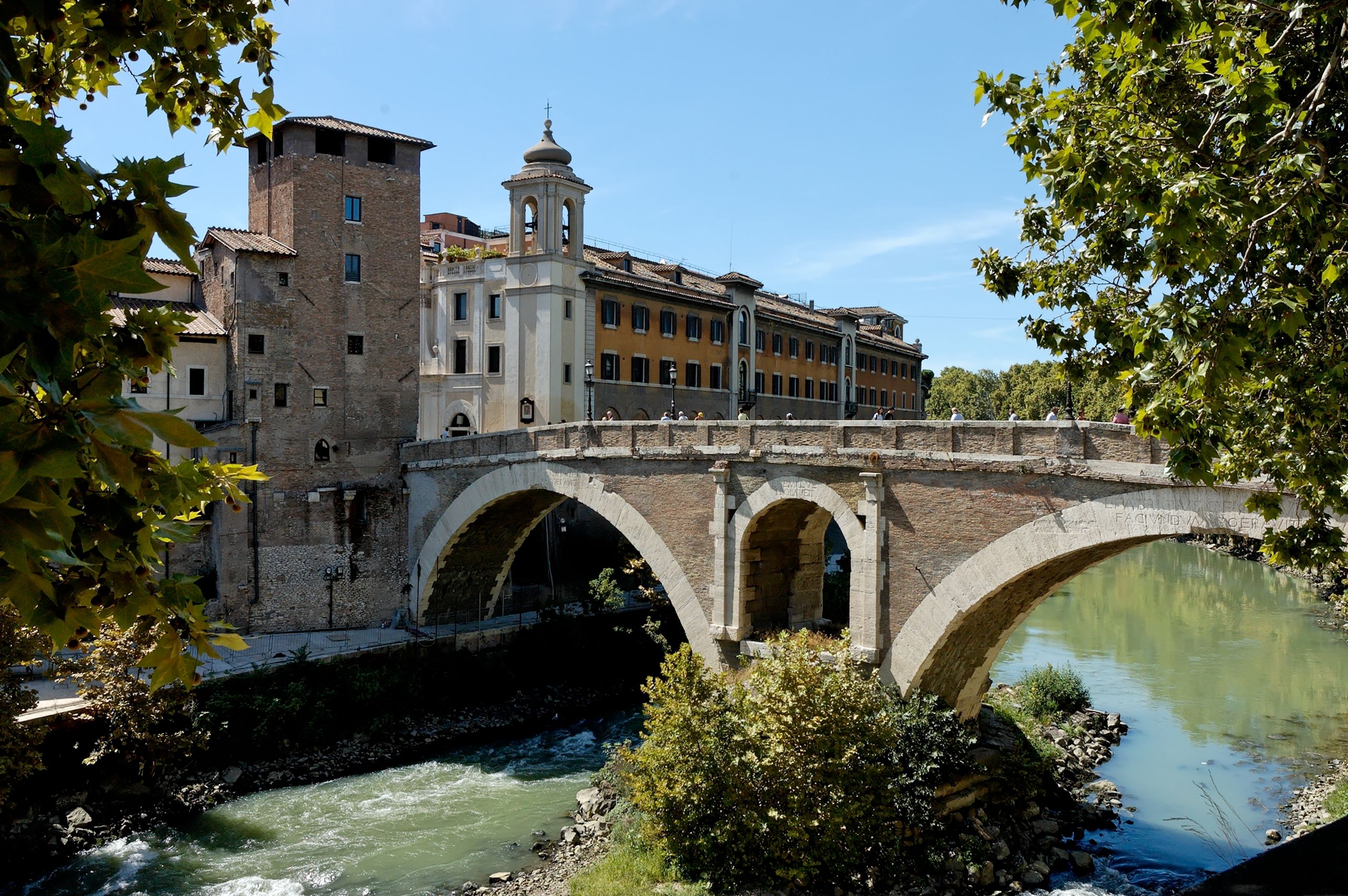
Engraved at the crest of the two large arches on both sides reads the family name of Lucio Fabricio. At first glance, this name seems simple… structures bearing the name of their constructor is common. But, given the context of Rome when this bridge was built, we gain a fuller understanding of the engraving. At this point in time, senators, who were voted for by their state, would gather in the Roman Forum to discuss politics. But in a time lacking social media, T.V., or even a printing press, the popularity of candidates for senator was primarily word of mouth. Thus, by inscribing your name on a bridge in ancient Rome, you’re essentially saying, “Hey, look at this bridge… yep, I built it. Impressive right? Ya, that’s the kind of stuff I do.” Bridges were campaign ads. And by using his family name, Lucio could guarantee that his predecessors would reap the rewards of credibility for centuries.
So, yes… the role of role systems in cities include transportation, identity and adaptation (callback to my essay). But, from this story of campaign bridges in ancient Rome, it seems that road systems have the ability to provide freedom of expression to a city’s people. Cities are primarily planned by governments, but much of the infrastructure is built by the citizens themselves. Whether it be a bridge in ancient Rome or highway in modern America, these infrastructure projects are pieces of art designed by the people and for the people.
🇮🇹 Cobblestone Voices
I cannot finish my first post without mentioning, of course, cobblestone. Covering many of the pedestrian and characteristic streets in Rome, I have grown particularly fond of its ability to transport me back in time. While walking around Trastevere, the neighborhood of my apartments and university, if I orient myself just right and erase the electric lights from my perception, I could very well be in 1670.
Something of interest to me, which sprung naturally from looking down at the cobblestone every day, is the pattern of such streets. Sampietrini, the name of Rome’s classic black basalt cobblestone roads, are found in two patterns: a classic grid and a recursive arch design, drawn below.
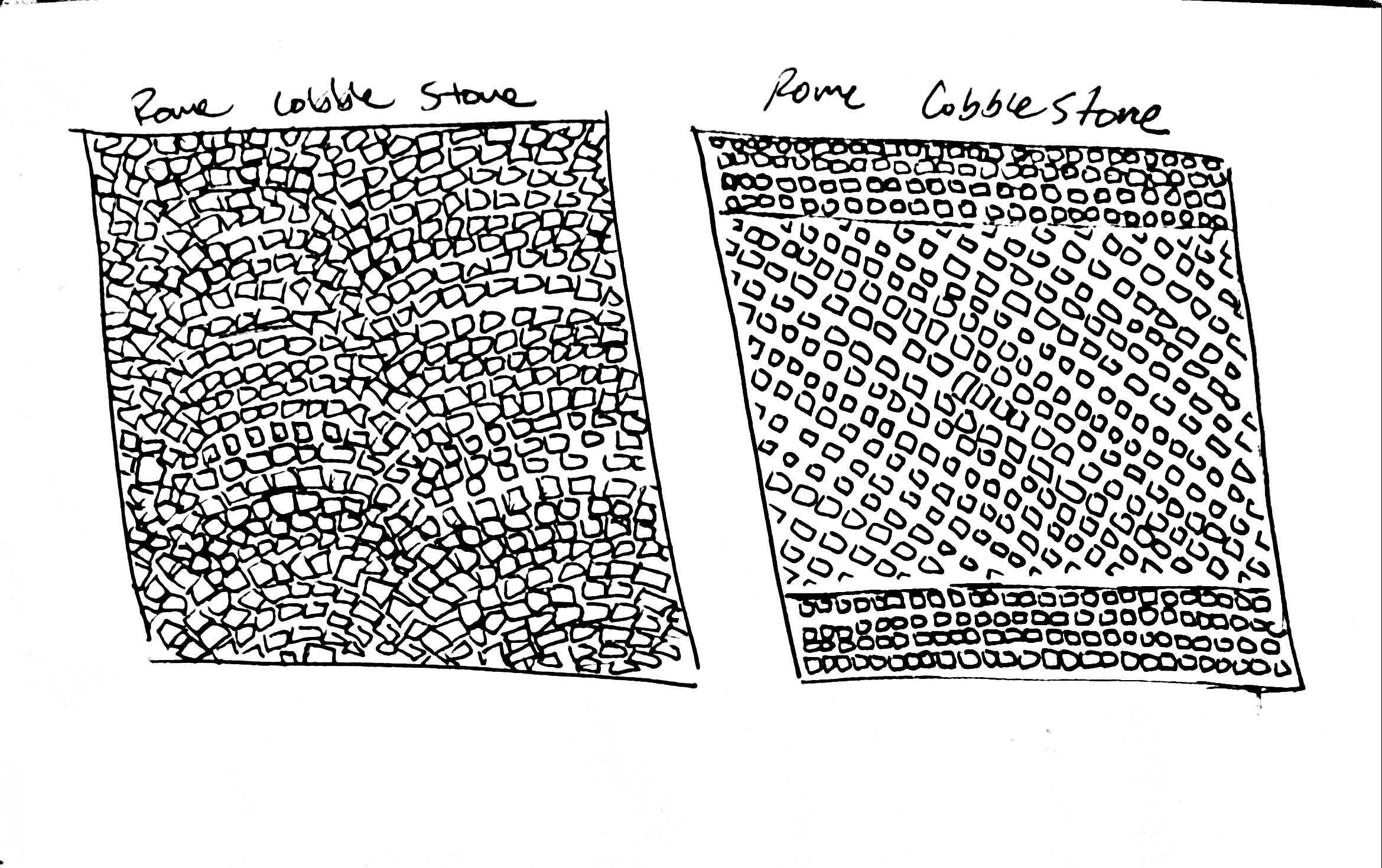
Both hypnotic in their repetitive natures, the cobblestone streets have proven to me, in new and fascinating ways, the importance of rode systems to a city. The cobblestone screams identity: Io sono Italiano! Translation: I am Italian! The city is always communicating to me: a whisper in the fog of the tiber; an accusation in the honk of a motorbike; a song in the bells of a church; And through the mossy irrigation of Rome’s cobblestone streets comes a lusty voice of cultural roots, sunken deep into the soil of a city whose pride is known worldwide. Io sono Italiano! Io sono Italiano! Io sono Italiano!
Weekly Anecdote: 🛤️ Rome Ripped my Jeans
This week’s story begins one late evening on the fringes of Trastevere. Let me set this up… it was quite cold on this particular night, so not only were my friends and I on a rush to get home, but my arms were also tucked pretty close to my side. So, when the pedestrian walk-sign illuminated a little green man, I decided to shuffle-run across the road. But, what I hadn’t accounted for were the large rails embedded in the road… the tram line. So, naturally, the brown soles of my Vans caught on this perfect tripping device, and…. Let’s just say this: As I write this, I sit here looking at a large scar on my lower palm and a similar one on my knee. I left a bit of myself on that road. But, that’s just a part of the job when you’re doing a research paper on road systems; how more intimate can you get? Ripped jeans is a small price for true first-hand research.
👋 Until Next Time And we made it! Thank you for reading my first Study Abroad blog post. Living in Rome is becoming exponentially more exciting, novel and mysterious every day. So if you thought this post was gripping, just wait… until next time. Ciao!